September 9, 2026
The modern industrial landscape relies heavily on engineered structural components to build everything from heavy machinery and agricultural equipment to complex architectural frameworks. Raw metal stock in its initial mill-produced form is rarely usable for demanding industrial applications without undergoing substantial structural modification and shaping. Manufacturers must transform flat plates, structural beams, and hollow tubular stock into precise, functional assemblies that consistently meet rigid engineering tolerances. Achieving this transformation requires a synchronized sequence of specialized manufacturing operations that turn raw elements into high-performance finished products.
The unified execution of primary metalworking disciplines ensures that structural integrity and exact dimensional tolerances are maintained throughout every stage of production. Businesses across diverse industrial sectors turn to specialized metal fabrication services to manage these complex multi-step manufacturing workflows efficiently and cost-effectively. By seamlessly blending initial precision cutting, exact mechanical forming, and durable structural welding, fabricators turn basic raw materials into fully realized engineering solutions. Understanding how these three foundational pillars interact reveals the immense operational value of an integrated manufacturing strategy.
Cutting Raw Stock to Precise Dimensions
Every successful manufacturing project begins with the accurate sizing and primary shaping of raw metal stock. High-precision thermal and mechanical tools such as fiber lasers, plasma torches, and abrasive waterjets are routinely deployed within modern metal fabrication services to achieve exact geometric profiles. Fiber lasers deliver exceptional edge precision on thin to medium-gauge sheet metals by using focused light beams to melt material instantly with minimal kerf width. High-definition plasma cutting handles thicker steel plates at high speeds, while waterjet systems cleanly slice heat-sensitive alloys without causing thermal distortion.
Computer Numerical Control technology guides these cutting tools with extreme repeatable accuracy based directly on detailed digital schematics. Automated nesting software translates complex CAD models into optimized cutting paths that minimize scrap material generated during production. By reducing kerf width and optimizing layout patterns, fabricators maximize material yield while maintaining strict dimensional tolerances. This initial precision prevents downstream alignment errors when cut pieces progress to subsequent shaping and processing stages.
Edge preparation is another crucial aspect of the initial cutting phase that directly influences all subsequent manufacturing steps. Equipment operators must clean cut bevels and remove lingering dross or burrs to prepare plate edges for smooth mechanical bending and strong weld penetration. Proper edge conditioning ensures that the metal behaves predictably under mechanical stress during forming operations. Consequently, clean initial cuts establish a solid structural foundation for every downstream manufacturing process across the shop floor.
Bending Sheet Metal Into Complex Geometries
Once flat components are cut to exact specifications, they frequently require three-dimensional transformation through controlled mechanical shaping. Advanced metal fabrication services utilize heavy-duty hydraulic press brakes, automated roll formers, and high-tonnage stamping presses to bend flat sheet metal into intricate geometries. Hydraulic and electric press brakes apply immense tonnage to force sheet metal into precision dies to achieve exact bend angles. Roll forming machinery gradually shapes long strips of metal through consecutive sets of mated rollers for continuous structural profiles.
Metal forming requires a deep understanding of physical metallurgy because different structural alloys react uniquely when subjected to intense mechanical stress. Experienced technicians must carefully account for springback, which is the natural elastic tendency of metal to partially return to its original shape after bending. Calculating bend allowances and deduction values ensures that final bent parts match design dimensions precisely after pressure release. Mastering these physical variables prevents material cracking and preserves structural integrity across all formed features.
Transforming flat sheets into rigid structural components adds significant mechanical strength and stiffness to the material without adding extra weight. Strategic structural bends increase moment of inertia, which is essential for lightweight engineering designs in demanding industries. Companies that invest in modern metal fabrication services gain access to sophisticated multi-axis machinery capable of producing complex custom shapes. These formed components fit together cleanly during assembly, reducing the need for excessive filler metal during final welding.
Joining Structural Parts With Welding Systems
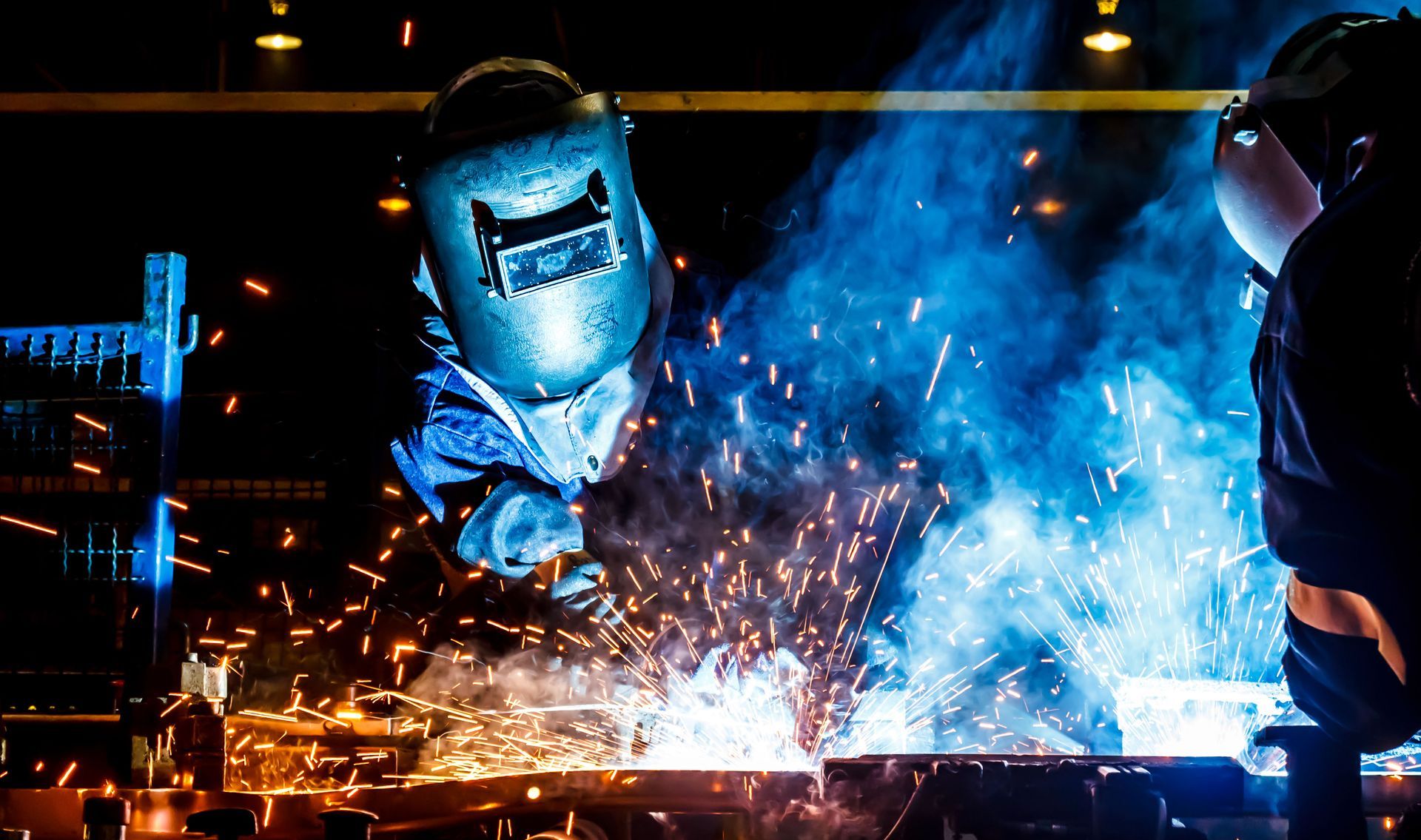
After components are cut and formed into their required shapes, they must be permanently joined through high-strength welding techniques. Comprehensive metal fabrication services employ various specialized welding methodologies, including Gas Metal Arc Welding, Gas Tungsten Arc Welding, and Shielded Metal Arc Welding. Gas Metal Arc Welding, commonly known as MIG welding, provides high deposition rates that are ideal for joining thick structural assemblies quickly and efficiently. Gas Tungsten Arc Welding, or TIG welding, offers superior aesthetic control and exceptional joint strength on thinner materials like stainless steel and aluminum.
Robotic automation and digital controls have revolutionized the modern welding landscape by increasing joint accuracy and repeatable quality across high-volume production runs. According to Technavio, incorporating robotic systems and automated welding into production lines can boost overall efficiency by as much as 30%. Automated robotic arms deliver consistent weld beads, minimize thermal distortion, and significantly shorten overall manufacturing cycle times. These technological enhancements ensure that heavy structural assemblies meet demanding code requirements while maintaining cost-effective delivery timelines.
Quality assurance remains paramount throughout the structural welding phase to guarantee long-term mechanical reliability under heavy working loads. Fabricators utilize non-destructive testing techniques, such as ultrasonic examination and magnetic particle testing, to verify complete weld soundness and joint integrity. Proper thermal management and interpass temperature monitoring prevent warping, residual stress build-up, and cracking within the heat-affected zones. Thorough inspection procedures ensure that finished welded assemblies safely endure extreme operational forces over extended service lifetimes.
Integrating Production Phases for High Efficiency
The true power of modern industrial manufacturing lies in synthesizing cutting, forming, and welding into a single, cohesive workflow. Leading metal fabrication services eliminate operational bottlenecks by orchestrating smooth material handoffs between cutting tables, press brakes, and welding cells. Digital shop-floor tracking systems allow project managers to monitor component progress in real time across the facility. Synchronized production scheduling reduces total lead times and prevents material damage caused by redundant intermediate handling and transport.
Applying Design for Manufacturability principles plays a pivotal role in successfully harmonizing these three core production disciplines. Engineers optimize part geometries early in the design phase to simplify downstream forming operations and minimize awkward welding angles. Collaborative planning between engineering design teams and shop technicians ensures that cutting layouts include alignment tabs and reference notches for easier fit-up. This proactive approach eliminates costly rework cycles, reduces material waste, and accelerates total fabrication speed significantly.
Industry sectors ranging from aerospace to commercial construction depend on this integrated manufacturing approach for high-volume output and quality assurance. Partnering with single-source metal fabrication services ensures uniform quality control from raw material receipt to final protective coating application. Centralized single-facility production minimizes communication breakdowns between separate vendors and guarantees strict compliance with industry standards. Consequently, industrial clients receive fully finished, turnkey metal assemblies ready for immediate operational deployment.
Combining cutting, forming, and welding into a unified manufacturing pipeline turns raw metal stock into sophisticated structural components. Each distinct phase relies directly upon the accuracy of the preceding step to deliver uncompromised quality, strength, and operational reliability. Utilizing specialized
metal fabrication services provides businesses with the advanced equipment, technical expertise, and streamlined processes necessary for complex projects. Understanding how these integrated disciplines interact empowers organizations to make informed decisions when sourcing durable, high-performance metal assemblies.
At FabEx, Inc, we bring decades of hands-on technical expertise to every cutting, forming, and welding project we manage for our clients. Our state-of-the-art facility and dedicated team of specialists stand ready to turn your complex engineering designs into high-precision structural reality. Contact us today to discuss your manufacturing requirements and discover how our comprehensive capabilities can elevate your next project.